Ear Age Test (Mosquito Tone)

Test your "ear age" by checking which high-frequency sounds you can hear.

Please be careful with the volume. Start low and do not force it. Headphones recommended.

Select Frequency

Now Playing:

---

Press a play button

  • Below 8,000Hz: Audible to almost everyone
  • Above 10,000Hz: Becomes harder to hear with age
  • Above 17,000Hz: "Mosquito tones" audible only to youth
Relationship between ear age and frequency. Below 8,000Hz is audible to almost everyone, above 10,000Hz becomes harder to hear with age, and above 17,000Hz are "mosquito tones" that only the young can hear.

Features

This tool performs efficient tasks with minimal input and makes daily work smoother.

How it works

  1. Press play and listen to a series of high-frequency tones.
  2. Select the highest frequency you were able to hear.
  3. Your answer is matched against age-based hearing benchmarks to calculate your ear age.
  4. The result is displayed visually along with the corresponding age range.

How the Mosquito Tone Test Measures Your Ear Age

As we age, it becomes harder to hear high-frequency sounds. The mosquito tone test (high-frequency sound) helps determine your ear age by checking which frequencies you can hear.

1

High-Frequency Sound Playback

High-frequency sounds from 8,000Hz to 17,000Hz are played in sequence from low to high. The higher the frequency, the harder it is to hear.

2

Determine Whether You Can Hear It

You can hear it

You can't hear it

We determine whether each frequency is "heard" or "not heard".

The highest frequency you can hear becomes an indicator of your ear age.

3

Calculate Your Ear Age

Your ear age is estimated based on the highest frequency you can hear.

Highest Frequency You Can Hear Estimated Ear Age
17,000Hz and above Teens (~20s)
13,000Hz Late 30s to 40s
10,000Hz Late 50s to early 60s
8,000Hz Early to mid 60s
Below 8,000Hz 70s and above

Why Does It Get Harder to Hear as You Age?

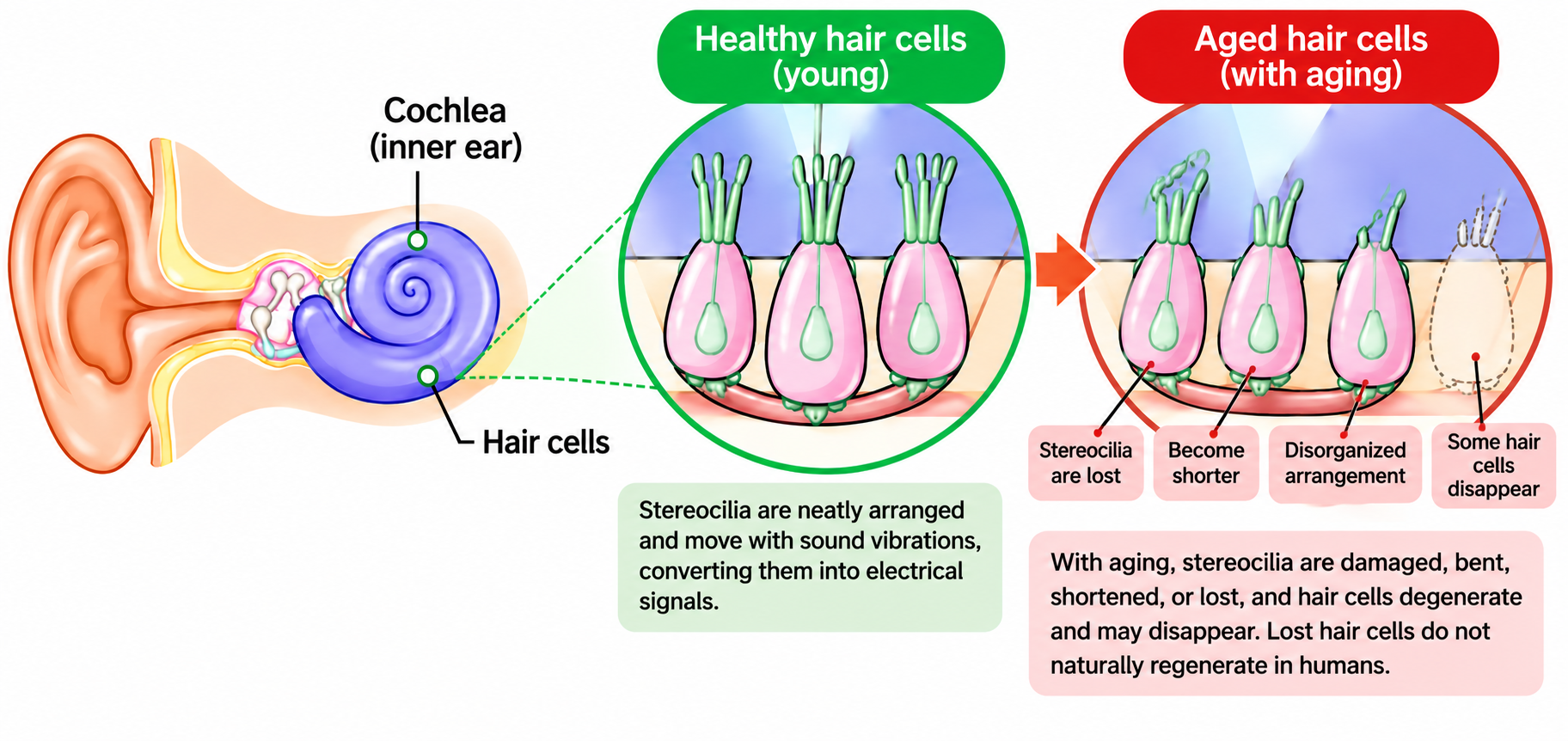
Hair cells in the cochlea (inner ear) convert sound vibrations into electrical signals and send them to the brain.

High-frequency sounds are detected in the deeper part of the cochlea. With age or exposure to loud sounds, hair cells may decrease or deteriorate, making high-frequency sounds harder to hear.
Please Note

  • This test provides a general guideline and does not diagnose hearing loss.

  • Results may vary due to physical condition or environment (e.g., earphones, speakers).
  • If you are concerned, please consult an ear, nose, and throat (ENT) specialist.

Check out our other tools

Share this tool with friends

🛠️ IVYWE企画開発のPortalサイトとおすすめサービス